


01. Editorial Vision
The “Blog Writing Prompt For Product Comparison Page” targets users deep in the commercial investigation phase, exhibiting a high level of purchase intent. This audience isn’t just browsing; they’re on the cusp of making a decision, actively weighing options, features, prices, and suitability against their specific needs. Their search intent is precisely defined: “Product A vs. Product B,” “Best [product category] for [specific use],” or “Alternatives to [Product X].” They are seeking clarity, validation, and ultimately, confidence in their next purchase.
Understanding the audience psychology is paramount. These users are often overwhelmed by choice paralysis, bombarded by marketing hype, and wary of biased reviews. They crave objective, fact-based information presented clearly and concisely. Emotionally, they are driven by a desire to optimize their investment, avoid buyer's remorse, and secure the "best" solution for their unique circumstances. Our content must resonate with these core emotional needs by offering a sense of relief and empowerment through well-researched, balanced insights.
To outrank competitors in this highly contested space, a robust E-E-A-T (Experience, Expertise, Authoritativeness, Trustworthiness) framework is not just beneficial, but essential.

<ul>

  <li style="margin-bottom: 8px !important;">**Experience:** Demonstrate genuine, hands-on interaction with the products. Share personal anecdotes, specific test results, and practical insights that only come from actual usage. For instance, instead of just listing battery life, describe a real-world usage scenario and how the battery performed.</li>

  <li style="margin-bottom: 8px !important;">**Expertise:** Showcase deep knowledge of the product category. This involves understanding technical specifications, industry trends, and the nuances that differentiate similar products. Citing data from reputable sources, explaining complex features in simple terms, and knowing which metrics truly matter to the user establishes undeniable expertise.</li>

  <li style="margin-bottom: 8px !important;">**Authoritativeness:** Build credibility through consistent, accurate information. Feature author bios that highlight relevant qualifications, certifications, or years of experience. Link to official product pages, industry studies, and other authoritative sources to back up claims. Over time, your brand becomes the go-to authority.</li>

  <li style="margin-bottom: 8px !important;">**Trustworthiness:** This is the bedrock. Be brutally honest about pros and cons for *all* products, even those you might be affiliating with. Transparency about affiliate relationships is crucial. Ensure data is current, pricing is accurate, and the comparisons are fair and unbiased. Address common user concerns directly and without evasion.</li>

</ul>
The emotional hook for comparison content lies in immediately acknowledging the reader's dilemma ("Struggling to decide?") and then offering a clear path to resolution ("We've rigorously tested X and Y so you don't have to"). Frame the content as a trusted advisor, not a salesperson. Focus on the benefits of making the *right* choice for *them*, highlighting how your analysis saves them time, money, and frustration. Use language that builds confidence, empowering them to make an informed decision rather than simply dictating one. This approach transforms a transactional search into a valuable, trusted interaction, significantly increasing conversion potential and brand loyalty.
02. Strategic Metadata
| Target Intent | Informational / Commercial Investigation |
| Readability Target | Flesch-Kincaid Grade 8 (Conversational) |
| Core Objective | Zero-Click Search Optimization |
03. The AI Prompt Library
V1 • SEO Pillar Post Architecture
You are an expert SEO content writer specialized in comprehensive product reviews and comparisons. Your task is to generate a detailed, authoritative, and unbiased product comparison blog post for [Product A] vs. [Product B].
  **Target Keywords:** "[Product A] vs [Product B]", "[Product A] comparison", "[Product B] alternatives", "best [product category] for [target user/need]", "[Product A] pros and cons", "[Product B] features review".
**Instructions:**

  1.  **H1:** Craft a compelling, keyword-rich title (e.g., "[Product A] vs. [Product B]: Which [Product Type] Reigns Supreme for Your Needs?").

  2.  **Introduction:** Hook the reader by acknowledging their dilemma and promising a definitive guide. Clearly state the article's objective: to provide a thorough, unbiased comparison.

  3.  **Product Overviews (H2 for each):**

      *   For [Product A]: Brief description, key features, target audience.

      *   For [Product B]: Brief description, key features, target audience.

  4.  **Key Comparison Categories (H2 for each):** Dedicate sections to crucial comparison points relevant to the products (e.g., Performance, Design & Build, Features, Price & Value, User Experience, Durability, Software/Ecosystem, Battery Life). For each point, clearly articulate how [Product A] and [Product B] perform relative to one another.

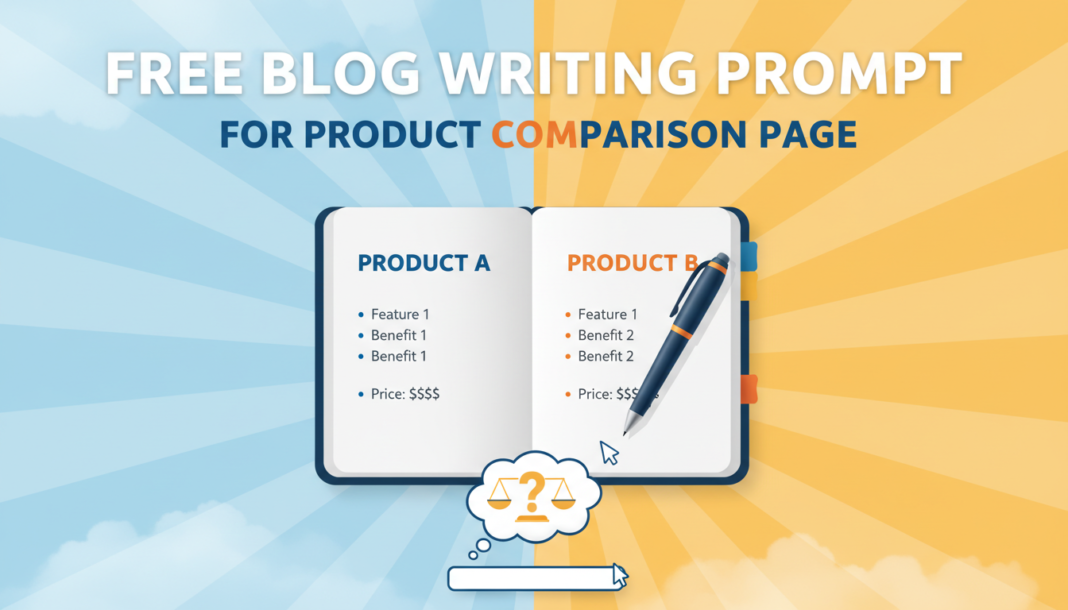
  5.  **Comparison Table:** Create a markdown table summarizing key specifications, features, pros, cons, and pricing for easy scanning.

  6.  **Pros & Cons (Separate H3 for each product):** Provide bulleted lists detailing the advantages and disadvantages of each product individually.

  7.  **Who Is It For? (Separate H3 for each product):** Clearly define the ideal user profile for [Product A] and [Product B], helping readers self-segment.

  8.  **Verdict/Recommendation (H2):** Conclude with a clear recommendation based on different user needs or priorities. Avoid a single "winner" unless one is unequivocally superior for most use cases; instead, recommend based on scenarios.

  9.  **FAQs (H2):** Address common questions users might have after reading the comparison.

  10. **Tone:** Authoritative, objective, informative, helpful.

  11. **E-E-A-T:** Emphasize demonstrating genuine experience (e.g., "In our tests, we found..."), deep expertise, clear authoritativeness, and unwavering trustworthiness (e.g., transparent about pros/cons, unbiased analysis).

  12. **Call to Action:** Encourage readers to click through to product pages for current pricing or further details.
**Specific Products to Compare:**

  *   **Product A:** [Specific Name of Product A], a [brief description, e.g., high-end noise-cancelling headphone].

  *   **Product B:** [Specific Name of Product B], a [brief description, e.g., budget-friendly alternative with great sound quality].

</div>

<button class="cp-btn" data-id="p1" style="width: 100% !important; background: #1A1A1A !important; color: #fff !important; border: none !important; padding: 12px !important; margin-top: 15px !important; cursor: pointer !important; font-weight: bold !important; text-transform: uppercase !important; font-size: 11px !important; letter-spacing: 1px !important;">Copy SEO Prompt</button>
V2 • Narrative Storytelling Method
You are a captivating storyteller and product enthusiast tasked with writing an engaging narrative comparison blog post between [Product A] and [Product B]. Focus on the user’s journey, emotional connection, and real-world scenarios rather than just technical specs.
  **Target Audience:** Readers who appreciate relatable stories and want to understand how products fit into their daily lives.
**Instructions:**

  1.  **Compelling Title:** Create a narrative-driven title that sparks curiosity (e.g., "The Daily Grind: How [Product A] and [Product B] Faced Our Toughest Challenges").

  2.  **Opening Hook:** Start with a relatable scenario or a common dilemma faced by users trying to choose between these product types. Introduce the "problem" that these two products aim to solve.

  3.  **Introducing the Protagonists:** Introduce [Product A] and [Product B] not just as gadgets, but as potential "companions" or "tools" in a user's life. Briefly set the stage for their comparison.

  4.  **The Journey (Comparison Points as Narrative Arcs):**

      *   Instead of dry categories, describe scenarios where each product shines or struggles.

      *   **Example 1 (e.g., Commute Story):** Describe a morning commute where [Product A]'s noise cancellation proves invaluable, while [Product B]'s portability is its hero.

      *   **Example 2 (e.g., Creative Flow):** Detail a creative session where [Product A]'s precision features elevate the work, contrasting with [Product B]'s user-friendliness for quick tasks.

      *   **Example 3 (e.g., Weekend Adventure):** Narrate how one product survived a rugged outdoor trip versus another's comfort during a relaxing escape.

  5.  **Character Arcs (Pros & Cons with Flavor):** Weave the advantages and disadvantages into the narrative naturally. Don't just list them; illustrate them through the story.

  6.  **The "Aha!" Moment (Decision Point):** Describe the point where the protagonist (the user) realizes which product is the better fit for *their* specific lifestyle or values.

  7.  **Conclusion & Reflection:** Summarize the narrative's outcome. Instead of a direct "buy this," offer a thoughtful reflection on what kind of user would truly benefit from each product, tying it back to the initial dilemma.

  8.  **Emotional Resonance:** Use evocative language, descriptive imagery, and relatable human experiences to connect with the reader on a deeper level.

  9.  **Tone:** Engaging, empathetic, personal, storytelling, reflective.
**Specific Products for Narrative:**

  *   **Product A:** [Specific Name of Product A], focusing on its [key narrative strength, e.g., robust features for pros].

  *   **Product B:** [Specific Name of Product B], focusing on its [key narrative strength, e.g., accessible simplicity for everyday use].

</div>

<button class="cp-btn" data-id="p2" style="width: 100% !important; background: #1A1A1A !important; color: #fff !important; border: none !important; padding: 12px !important; margin-top: 15px !important; cursor: pointer !important; font-weight: bold !important; text-transform: uppercase !important; font-size: 11px !important; letter-spacing: 1px !important;">Copy Narrative Prompt</button>
V3 • High-Engagement Viral Listicle
You are a dynamic and concise content creator, skilled in crafting viral, high-engagement listicles. Generate a product comparison listicle that is punchy, scannable, and designed for maximum shareability, comparing [Product A] and [Product B].
  **Target Audience:** Busy readers looking for quick answers, strong opinions, and clear differentiation.
**Instructions:**

  1.  **Clickable Title:** Craft an attention-grabbing, curiosity-inducing title (e.g., "Stop Scrolling! [Product A] vs. [Product B]: The Only Comparison You Need to Read!"). Use numbers or strong action verbs.

  2.  **Short & Sweet Intro:** Immediately hook the reader and state the purpose: to quickly help them choose between the two products.

  3.  **Numbered/Bulleted Comparison Points:** Dedicate each major point to a distinct aspect where the products differ significantly. Use bold, clear headings for each point.

      *   **Example Points:**

          *   **Performance Face-Off:** Who's truly faster?

          *   **Price Tag Showdown:** Budget-friendly or premium splurge?

          *   **Design Duel:** Style icon or practical workhorse?

          *   **Feature Frenzy:** What does each *really* offer?

          *   **The X-Factor:** What makes one stand out?

      *   For each point, briefly state how [Product A] performs, then how [Product B] performs, with a clear verdict or differentiation. Use strong, decisive language.

  4.  **"Who Should Buy Which?" (Quick Guide):** Create a highly scannable section clearly outlining which product is best for specific user types or scenarios in a bulleted format.

  5.  **The Ultimate Verdict (H2):** Deliver a clear, concise final recommendation. Emphasize why one might be superior for a particular user, or if it's a tie, explain the deciding factors.

  6.  **Action-Oriented CTA:** Direct readers to "Shop Now," "Compare Prices," or "Read More Reviews."

  7.  **Tone:** Energetic, direct, opinionated (where justified), confident, concise, highly scannable. Use strong verbs and evocative adjectives.
**Specific Products for Listicle:**

  *   **Product A:** [Specific Name of Product A], highlighting its [key strength for a listicle, e.g., cutting-edge features].

  *   **Product B:** [Specific Name of Product B], highlighting its [key strength for a listicle, e.g., incredible value proposition].

</div>

<button class="cp-btn" data-id="p3" style="width: 100% !important; background: #1A1A1A !important; color: #fff !important; border: none !important; padding: 12px !important; margin-top: 15px !important; cursor: pointer !important; font-weight: bold !important; text-transform: uppercase !important; font-size: 11px !important; letter-spacing: 1px !important;">Copy Listicle Prompt</button>
04. Market Implementation
Implementing a robust product comparison page strategy yields significant ROI across multiple business objectives. For businesses engaged in affiliate marketing, these pages are goldmines. Users searching for direct comparisons are typically at the bottom of the sales funnel, indicating high purchase intent. By providing an unbiased, E-E-A-T-driven comparison, a blog can convert these high-intent visitors into direct affiliate clicks, resulting in commission revenue. The transparency and depth of analysis build trust, encouraging repeat visits and future conversions.
Beyond direct affiliate revenue, product comparison pages serve as powerful lead generation tools. By offering a downloadable "Ultimate Buyer's Guide" or exclusive discount codes in exchange for an email address, businesses can capture valuable leads for remarketing campaigns. For e-commerce businesses that sell multiple competing products (or even their own product against a competitor), a well-crafted comparison page can directly guide users to the optimal product within their inventory, boosting direct sales and reducing choice paralysis.
The long-term ROI is equally compelling. High-quality comparison content significantly enhances a brand's authority and trustworthiness in its niche. It establishes the site as an expert resource, leading to improved organic search rankings, increased domain authority, and a stronger brand reputation. This translates into sustained organic traffic, reduced customer acquisition costs, and higher customer lifetime value (CLTV). Furthermore, by preemptively answering common pre-purchase questions, these pages can drastically reduce the burden on customer service teams, freeing up resources and improving overall customer satisfaction. The rich data and insights gathered for comparison articles can also be repurposed into various content formats—infographics, social media snippets, video reviews—extending their value and reach across different channels.
Sample AI Generation (V1 Preview)
Struggling to choose between the Apple AirPods Pro 2 and the Sony WH-1000XM5? You’re not alone. In a market flooded with premium audio gear, these two titans stand out, each promising an unrivaled listening experience. But which one truly delivers for *your* specific needs, budget, and lifestyle? Our definitive guide cuts through the marketing noise, offering an unbiased, in-depth comparison of features, performance, comfort, and value to help you make the most informed decision.