


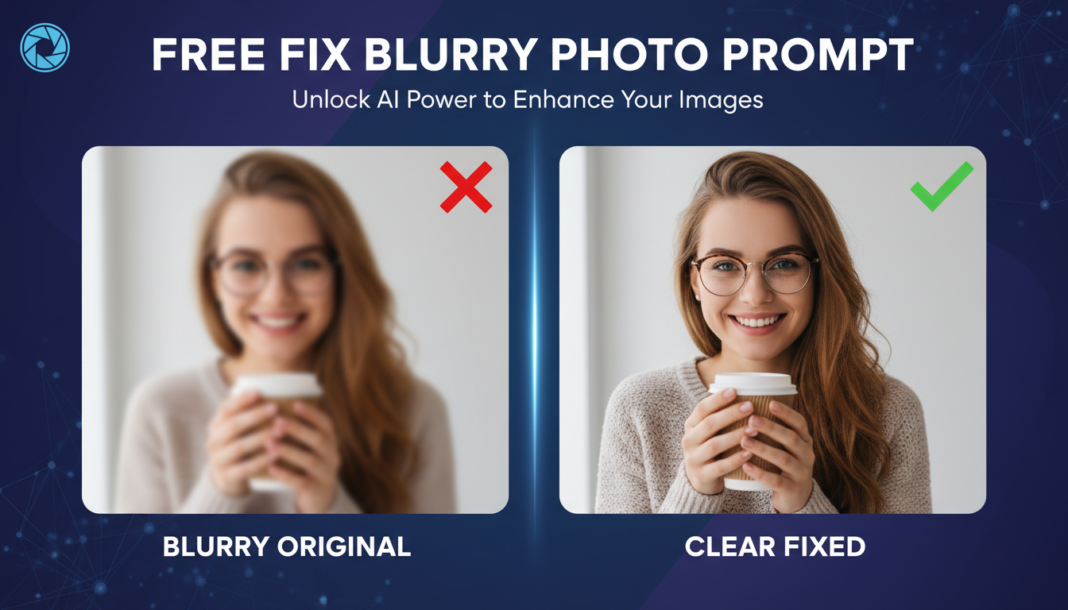
Executive Summary: Fix Blurry Photo Prompts leverage advanced AI, primarily deep learning models, to restore image clarity. They instruct generative AI to identify and reverse degradation caused by motion blur, out-of-focus issues, or low resolution. This involves denoising, sharpening edges, reconstructing lost details, and often applying super-resolution techniques to create perceptually clearer and higher-fidelity outputs by inferring missing information from the surrounding context.
01. Triple Prompt Toolkit
V1 • Standard Correction
Deblur and sharpen the input image. Reduce overall blur and noise, enhancing edges and textures for improved clarity and focus. Output a clear, natural-looking photograph.
✍️ Editorial Tip: To adjust intensity, add parameters like `–sharpen
V2 • Cinematic High-Fidelity
Apply advanced deblurring and high-fidelity sharpening to the image, aiming for a cinematic aesthetic. Introduce subtle depth, rich contrast, and a professional, film-like clarity, ensuring atmospheric realism without artificiality.
✍️ Editorial Tip: Customize “cinematic aesthetic” with terms like “vintage film grain” or “modern HDR look” to guide specific visual styles.
V3 • Hyper-Realistic Detail
Execute hyper-realistic deblurring and super-resolution. Reconstruct fine textures, micro-details, and intricate patterns with extreme precision. Eliminate all blur and noise, delivering an ultra-sharp, high-definition photograph with true-to-life clarity.
✍️ Editorial Tip: Adjust “micro-details” or “intricate patterns” to focus on specific elements like “skin pores,” “fabric textures,” or “foliage details.”
02. Pro Customization Table
| Variable | Replace With | Result | Impact |
|---|---|---|---|
| `[Blur Type]` | `heavy motion blur`, `slight out-of-focus`, `grainy low-res` | Directs the AI to specific blur characteristics for targeted correction and artifact removal. | High |
| `[Output Style]` | `photorealistic`, `artistic interpretation`, `dreamy aesthetic` | Modifies the final render’s aesthetic beyond just sharpness, influencing creative interpretation. | High |
| `[Detail Level]` | `subtle enhancement`, `microscopic precision`, `smooth painterly finish` | Controls the degree of sharpness, texture reconstruction, and overall detail fidelity applied. | Medium |
| `[Color Grading]` | `vibrant colors`, `muted tones`, `monochromatic black and white` | Influences the color palette and tonal range of the enhanced output, adding atmosphere. | Medium |