


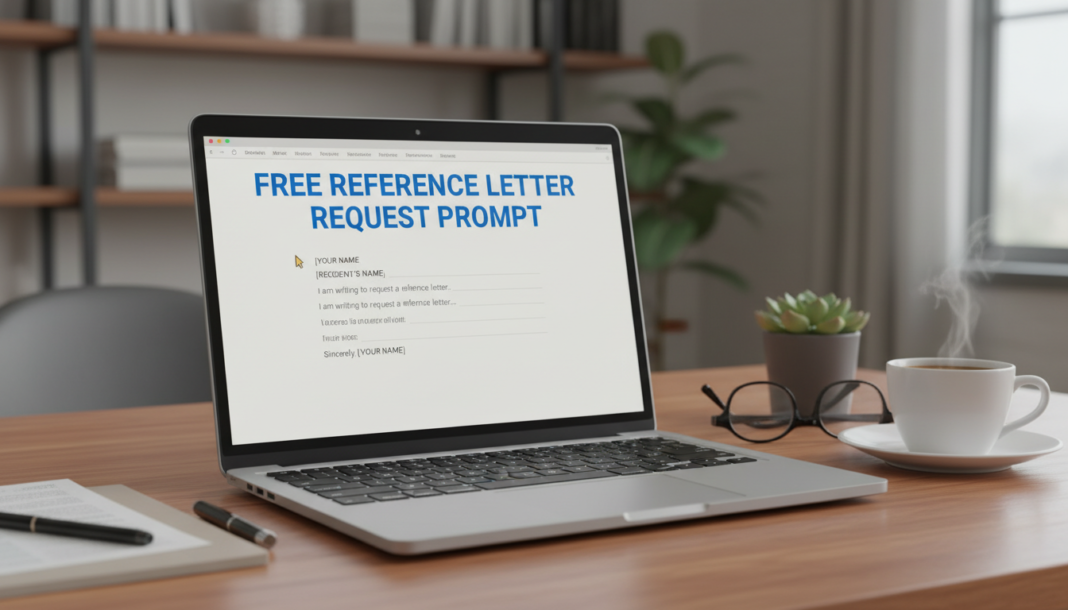
Strategic Context: The “Reference letter request prompt” taps into the powerful psychology of social proof and reciprocity. It’s an invitation for someone to validate your past performance or character, inherently boosting your credibility. For the sender, it’s a strategic move to leverage established trust, demonstrating competence or value through an external endorsement. The recipient, feeling valued for their insight, is more likely to convert this goodwill into a helpful action, strengthening the connection and achieving career or business goals.
01. Triple-Threat Prompt Library
V1 • Cold Outreach Architecture
“As an elite direct response copywriter, draft an AI prompt for a professional cold email requesting a reference letter. The prompt should instruct the AI to:
1. Clearly state the purpose in the first paragraph: seeking a reference for a [specific opportunity/role, e.g., Senior Marketing Manager position at [Company X]].
2. Briefly remind the recipient of a specific past positive interaction, project, or mutual connection that justifies this request (e.g., ‘our work together on [Project Y] at [Previous Company]’).
3. Specify what kind of qualities or achievements should be highlighted (e.g., ‘leadership skills and data-driven results’).
4. Provide a clear deadline for submission.
5. Offer to provide all necessary details and make the process as easy as possible.
6. Include a low-friction CTA (e.g., ‘Would you be open to a quick 10-minute chat to discuss this?’).
7. Maintain a respectful, professional, and appreciative tone.”
1. Clearly state the purpose in the first paragraph: seeking a reference for a [specific opportunity/role, e.g., Senior Marketing Manager position at [Company X]].
2. Briefly remind the recipient of a specific past positive interaction, project, or mutual connection that justifies this request (e.g., ‘our work together on [Project Y] at [Previous Company]’).
3. Specify what kind of qualities or achievements should be highlighted (e.g., ‘leadership skills and data-driven results’).
4. Provide a clear deadline for submission.
5. Offer to provide all necessary details and make the process as easy as possible.
6. Include a low-friction CTA (e.g., ‘Would you be open to a quick 10-minute chat to discuss this?’).
7. Maintain a respectful, professional, and appreciative tone.”
✍️ Editorial Tip: Maximize Open Rates by personalizing the subject line with a mutual connection’s name or a direct question, e.g., “Intro via [Mutual Name] / Quick Question: [Your Name]”.
V2 • Authority-Building Newsletter
“As an elite direct response copywriter, draft an AI prompt for integrating a reference letter request into a value-driven newsletter. The prompt should instruct the AI to:
1. Frame the request within a broader narrative of your journey or a recent success story (e.g., ‘As we celebrate [recent milestone/achievement]’).
2. Connect the recipient’s past support or interaction with your current progress, building on existing trust (e.g., ‘Your insights during [past interaction] were instrumental…’).
3. Explain how a reference would fuel future growth or impact, making it a shared objective.
4. Offer to provide specific guidelines or examples to ease the process.
5. Include a soft, appreciative CTA (e.g., ‘If you feel inspired to contribute, please let me know.’).
6. Maintain the newsletter’s usual tone, blending the ask seamlessly with valuable content.”
1. Frame the request within a broader narrative of your journey or a recent success story (e.g., ‘As we celebrate [recent milestone/achievement]’).
2. Connect the recipient’s past support or interaction with your current progress, building on existing trust (e.g., ‘Your insights during [past interaction] were instrumental…’).
3. Explain how a reference would fuel future growth or impact, making it a shared objective.
4. Offer to provide specific guidelines or examples to ease the process.
5. Include a soft, appreciative CTA (e.g., ‘If you feel inspired to contribute, please let me know.’).
6. Maintain the newsletter’s usual tone, blending the ask seamlessly with valuable content.”
✍️ Editorial Tip: Blend storytelling by framing the request within a narrative of your professional journey or a shared success, making the ask a natural extension of your valued connection.
V3 • Re-Engagement / Win-Back
“As an elite direct response copywriter, draft an AI prompt for a win-back/re-engagement email that strategically requests a reference letter. The prompt should instruct the AI to:
1. Start by re-establishing a warm connection, referencing a specific positive memory or shared project (e.g., ‘It’s been a while since our collaboration on [Project Z]!’).
2. Briefly share an update on your recent accomplishments or progress, implicitly demonstrating continued value (e.g., ‘Since then, I’ve [achieved X]…’).
3. Transition smoothly to the reference request, linking it to your current professional trajectory (e.g., ‘As I embark on [new endeavor], your perspective is invaluable.’).
4. Specify the type of reference needed and the opportunity it’s for.
5. Emphasize that the process will be minimal effort for them and offer to draft content if helpful.
6. Provide a clear, low-barrier CTA (e.g., ‘Are you in a position to offer a brief endorsement?’).
7. Maintain an appreciative and respectful tone, acknowledging their time.”
1. Start by re-establishing a warm connection, referencing a specific positive memory or shared project (e.g., ‘It’s been a while since our collaboration on [Project Z]!’).
2. Briefly share an update on your recent accomplishments or progress, implicitly demonstrating continued value (e.g., ‘Since then, I’ve [achieved X]…’).
3. Transition smoothly to the reference request, linking it to your current professional trajectory (e.g., ‘As I embark on [new endeavor], your perspective is invaluable.’).
4. Specify the type of reference needed and the opportunity it’s for.
5. Emphasize that the process will be minimal effort for them and offer to draft content if helpful.
6. Provide a clear, low-barrier CTA (e.g., ‘Are you in a position to offer a brief endorsement?’).
7. Maintain an appreciative and respectful tone, acknowledging their time.”
✍️ Editorial Tip: For re-engagement, use curiosity or a hint of exclusivity in the subject line, like “A Quick Thought from [Your Name]?” or “Time-Sensitive Opportunity (Your Input Needed!)” to spark interest.
02. Pro Customization Matrix
| Variable to Swap | Replacement | Psychological Impact | Priority |
|---|---|---|---|
| Recipient’s Name | Full Name, First Name, “Valued Colleague” | Increases personalization and perceived importance, fostering a stronger connection. | High |
| Request Context/Purpose | “New Career Opportunity,” “Accelerator Program,” “Business Partnership,” “Client Testimonial” | Provides clarity and intrinsic motivation; tailors the ask to a specific, understandable goal. | High |
| Suggested Reference Content | “Focus on [Skill A] & [Achievement B],” “Highlight our collaboration on [Project X],” “Speak to my integrity/leadership” | Reduces mental friction for the referrer, guiding them to provide impactful and relevant details effortlessly. | Medium |
| Call to Action (CTA) | “Reply to this email,” “Schedule a quick call (link),” “Click here to fill out a brief form” | Offers clear, low-friction options, respecting the referrer’s time and preferred communication method. | Medium |