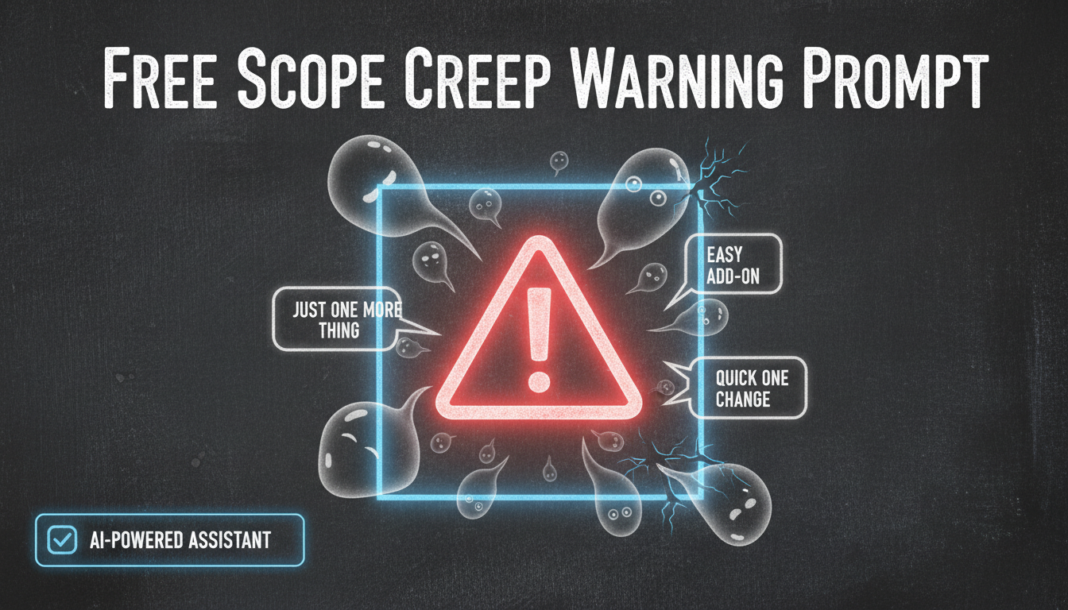
Strategic Context: The “Scope creep warning prompt” leverages the psychological need for control and predictability in project management. By proactively addressing potential scope expansion, it prevents future friction and reinforces professional boundaries. Its conversion intent is to initiate a constructive dialogue, re-align expectations, and offer a clear path for managing additional requests, safeguarding project success and client satisfaction while identifying opportunities for structured upselling.
01. Triple-Threat Prompt Library
V1 • Cold Outreach Architecture
Generate a cold outreach email that introduces our project management consulting services. The email should focus on the common business pain point of scope creep, without directly accusing the recipient of having it. Structure it with an intriguing subject line, a personalized opening, a paragraph explaining the silent costs of scope creep (time, budget, morale), a brief introduction to how our service prevents this, and a clear, low-friction call to action for a quick discovery call. Use placeholders for client name, industry, and our company name.
✍️ Editorial Tip: A/B test subject lines that either promise a solution (‘Avoid Project Overruns’) or pose a direct question (‘Is Scope Creep Costing You?’). Ensure your CTA asks for a specific, small commitment like ’15-min chat.’
V2 • Authority-Building Newsletter
Draft a newsletter segment for our subscribers about the critical importance of managing project scope effectively. The tone should be educational and authoritative, positioning us as experts. Include an engaging headline, a short introduction to what scope creep is and why it’s dangerous, 3-4 actionable tips for prevention (e.g., clear requirements, change control, regular check-ins), and a gentle call to action to download a more comprehensive guide or attend a webinar. Emphasize value and knowledge sharing.
✍️ Editorial Tip: To boost engagement, weave a brief, anonymous case study or a common client anecdote into the introduction to make the concept of scope creep more relatable and human. Consider a CTA like ‘Download our free toolkit’ for immediate value.
V3 • Re-Engagement / Win-Back
Create a re-engagement email for a lead who previously showed interest in our project management software/services but has gone silent. The email should gently acknowledge their previous interest and inquire if project complexities, specifically unchecked scope growth, might be a factor in their pause. Offer to re-engage with a fresh perspective or a specific resource. Use an empathetic tone, a personalized greeting, a subtle re-pitch of our solution as a way to regain control, and a simple, no-pressure CTA to restart the conversation.
✍️ Editorial Tip: Inject a soft urgency by mentioning a limited-time offer on a discovery session, or use a curiosity-driven subject line like ‘Still battling project chaos, [Name]?’ to pique their interest and prompt an open.
02. Pro Customization Matrix
Variable to Swap
Replacement
Impact
Priority
`[Client/Lead Name]`
`[First Name]` (e.g., “Hi John,”)
Direct address fosters personal connection and shows respect, significantly increasing engagement.
High
`[Specific Project / Area]`
`[Their Current Initiative]` (e.g., “your recent marketing campaign”)
Demonstrates prior research and understanding of their specific business context, making the message highly relevant.
Medium
`[Vague ‘Our Solution’]`
`[Our ‘ScopeGuard’ Framework]` (or similar branded name)
Adds branding, memorability, and a perception of a proprietary, expert-driven solution rather than generic services.
Medium
`[Generic Call to Action]`
`[Book a 15-Min Scope Clarity Call]` or `[Download Your Scope Control Checklist]`
Specific, low-commitment CTAs reduce friction, clearly communicate the next step’s value, and manage expectations.
We are the Editorial Team at Bloggedge, a group of dedicated Tech Researchers and Data Analysts. Our mission is to break down complex AI and Global Tech developments into simple, easy-to-read guides. By utilizing our structured 'Information Hub,' we help readers worldwide stay ahead of digital trends without the confusion of technical jargon.